


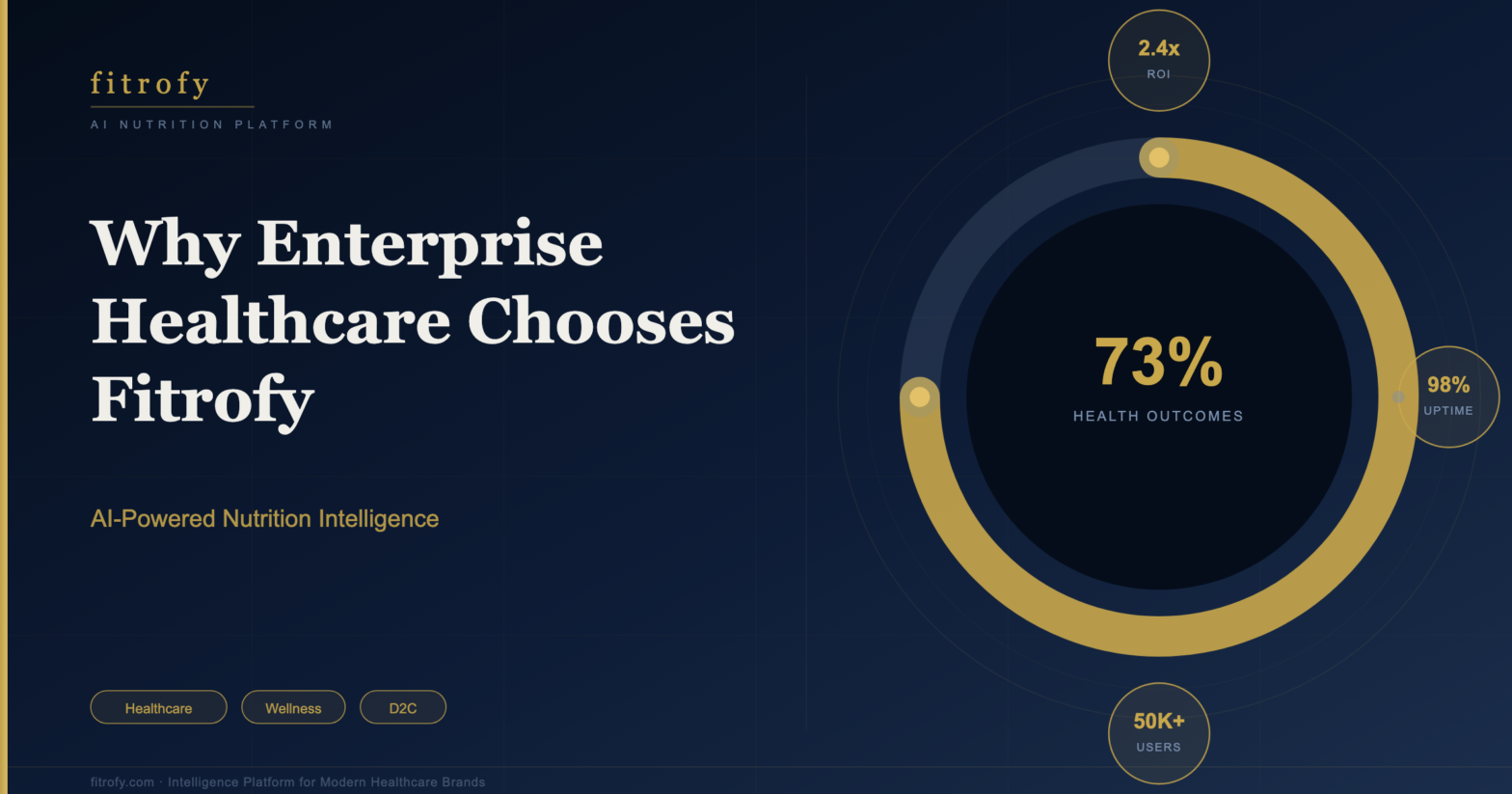
The Rising Stakes of Employee Wellness in Enterprise Healthcare
Employee health is no longer a peripheral HR concern—it’s a strategic imperative. According to the CDC, chronic diseases account for an estimated 90% of the nation’s $4.5 trillion in annual healthcare expenditures, and poor nutrition is a leading driver of these conditions. For enterprise healthcare companies managing thousands of employees, the financial and human cost of unmanaged wellness is staggering.
This is precisely why forward-thinking organizations are embracing Fitrofy, an AI-powered platform purpose-built to deliver personalized, scalable nutrition programs across the enterprise. By combining clinical-grade insights with intelligent automation, Fitrofy is redefining how large organizations approach employee wellness.
What Sets Fitrofy’s Nutrition AI Apart
Generic wellness apps fall short in enterprise environments because they fail to personalize at scale. Fitrofy’s nutrition AI analyzes individual health data, dietary preferences, medical history, and behavioral patterns to deliver hyper-personalized recommendations for every employee—simultaneously and seamlessly.
1. Personalization Without Compromise
Fitrofy’s machine learning models adapt to each user in real time, generating dynamic meal plans and nutrition guidance that evolve with progress. This level of individualization, once reserved for one-on-one clinical consultations, is now available to entire workforces.
2. Clinical Integration and Compliance
Built for enterprise health ecosystems, Fitrofy integrates with existing EHR systems, wearables, and benefits platforms while maintaining HIPAA and GDPR compliance. This makes data-driven nutrition a natural extension of broader healthcare delivery.
3. Measurable, Reportable Outcomes
Enterprise leaders demand accountability. Fitrofy provides robust analytics dashboards that track engagement, biometric improvements, and program ROI—giving HR and clinical teams the data they need to justify investment.
The Business Case for Fitrofy
The numbers speak clearly. Research published by the Harvard Business Review found that well-designed workplace wellness programs can yield a return of $3.27 for every $1 spent on medical costs and $2.73 in reduced absenteeism. With nutrition as a central pillar, the impact compounds.
Enterprise healthcare companies choose Fitrofy because it delivers:
- Scalability: Onboard thousands of employees without proportional increases in staff or cost.
- Engagement: AI-driven personalization drives participation rates significantly higher than traditional programs.
- Cost containment: Preventive nutrition reduces the incidence of expensive chronic conditions.
- Brand differentiation: A best-in-class wellness benefit strengthens recruitment and retention.
How Leading Organizations Deploy Fitrofy
Implementation is streamlined and low-friction. Most enterprise clients follow a proven rollout path:
- Discovery and integration with existing health and HR systems.
- Pilot deployment across a representative employee cohort to validate outcomes.
- Full-scale launch with ongoing AI optimization and quarterly performance reviews.
This structured approach ensures rapid time-to-value while minimizing operational disruption.
The Future of Workforce Nutrition Is Intelligent
As healthcare costs climb and talent competition intensifies, enterprise organizations cannot afford one-size-fits-all wellness initiatives. Fitrofy empowers companies to deliver clinically informed, deeply personalized nutrition at enterprise scale—turning employee wellness from a cost center into a strategic advantage.
Ready to transform how your organization approaches nutrition and preventive health? Connect with the Fitrofy team today to schedule a personalized demo and discover the measurable impact of nutrition AI built for the enterprise.